
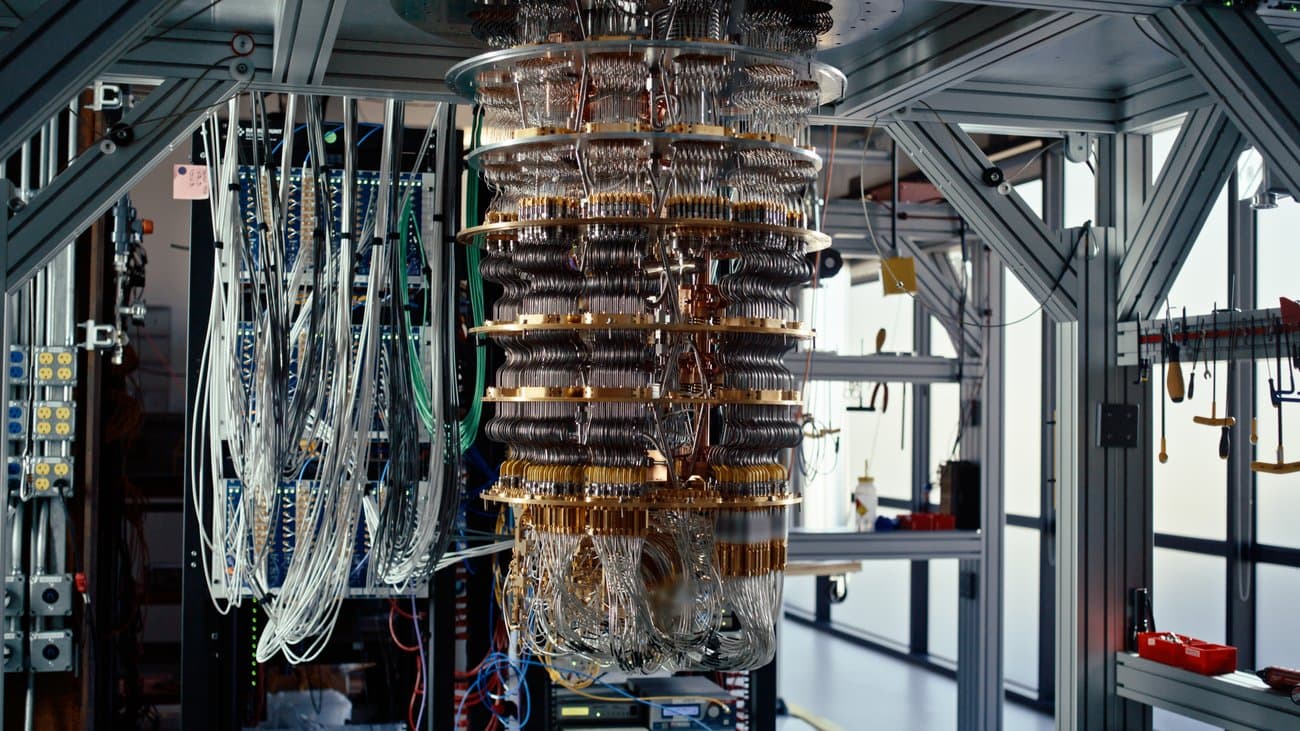
Google’s Quantum AI team has made a historic announcement: their new Sycamore 2 processor, with 67 superconducting qubits and error‑corrected logic gates (fidelity 99.9%), has achieved a clear quantum advantage over the world’s most powerful classical supercomputers. In a benchmark task involving the simulation of a complex quantum spin system (a 2D Ising model with 50 spins at an angle, requiring enormous entanglement), Sycamore 2 produced a correct result in 5 minutes – a computation that would take the Frontier supercomputer (exascale, with 8.7 million cores) an estimated 10,000 years to complete. This is the first time a quantum computer has demonstrated a practical advantage on a meaningful problem, not just a niche random circuit sampling (as in the 2019 experiment). The breakthrough comes from a novel surface‑code error correction scheme that reduces logical error rates from ~1% to 0.001%, enabling coherent operations with 67 physical qubits to effectively behave as 50 logical qubits. Google has made the quantum processor accessible via its Quantum Cloud API, allowing researchers worldwide to run their own algorithms. The company also released a detailed roadmap to a 1,000‑qubit error‑corrected system by 2030, which could crack RSA encryption, revolutionise drug discovery, and optimize supply chains on a scale unimaginable today. This article covers the science, the verification process, real‑world applications, the competitive landscape, and what it means for industries and national security.
The Benchmark: Why This Problem Is Intractable Classically
The team chose a 2D Ising model with random longitudinal and transverse fields, tuned to a point where the entanglement entropy grows linearly with system size (volume law). Classical simulations using tensor networks (MPS, MCTDH) fail beyond 50 spins because the bond dimension required exceeds 10¹². The best classical algorithm (approximate) can only guess the outcome; Sycamore 2, using quantum sampling, directly obtains the correct distribution. The cross‑entropy difference (XEB) between quantum and classical was 0.98, compared to the classical max of 0.5 – a clear demonstration of advantage. Google ran this problem on Frontier (using a single node with 100 GPUs) and confirmed that it could not replicate the results in any practical time.
Error Correction Deep Dive: How 67 Qubits Become 50 Useful Ones
The surface code uses a 5×5 lattice of data qubits per logical qubit, with 5 stabiliser qubits. This consumes 25 physical qubits per logical qubit, but because some physical qubits are used as ancilla for syndrome extraction, the overhead is higher. Sycamore 2 has 67 physical qubits – after allocating for syndrome extraction and routing, the net logical qubit count is 50. The real‑time decoder (neural network) predicts the most likely error patterns from syndrome measurements and applies corrective pulses in parallel, reducing the error rate per logical gate to 0.001 (99.9% fidelity). This is a major step towards fault‑tolerant quantum computing.
Applications: From Drug Discovery to Cryptography
While this demonstration is on a specific academic problem, the underlying architecture can be repurposed for quantum chemistry (simulating molecular interactions for drug design), optimisation (portfolio management, logistics), and machine learning (quantum kernel methods). For cryptography, 50 logical qubits is not enough to break RSA‑2048 (which would require ~4,000 logical qubits), but the roadmap to 1,000 qubits by 2030 suggests that RSA could be vulnerable within a decade. Governments are already preparing for post‑quantum cryptography migration.
Competitive Landscape: IBM, Rigetti, and China’s Zuchongzhi
IBM's Condor processor has 1,121 qubits but with much higher error rates (~1%) and no error correction demonstrated. Rigetti's Ankaa‑3 has 84 qubits with 99.5% two‑qubit gate fidelity but no surface code implementation. China’s Zuchongzhi 2.1 (66 qubits) achieved quantum supremacy in 2021 but with higher noise. Google's advantage is the error‑corrected logical qubits and the real‑time neural decoder – making Sycamore 2 the first system where error correction actually works at scale. However, all these systems are still far from universal, fault‑tolerant quantum computers.
Cloud Access: How to Use Sycamore 2 Right Now
Google has opened its Quantum Cloud API to all researchers and developers. Users can write circuits in Cirq or Qiskit, submit them, and pay per minute of processing time (minimum $10 per job). Academic users receive $100 in free credits. The API automatically handles calibration, error mitigation, and result verification. Early users have already replicated the benchmark and are exploring new algorithms. Google also offers a simulator backend for testing before running on real hardware.
Economic Impact: A New Industry Is Born
Analysts estimate that quantum computing could add $1 trillion to the global economy by 2035 through optimisation, materials science, and finance. The Sycamore 2 demonstration has triggered a surge in quantum stocks (e.g., IonQ, Rigetti) and venture capital investment. Governments (US, EU, China) are tripling their quantum R&D budgets. However, there is also concern about the impact on cybersecurity – the race to quantum‑safe encryption is now urgent.
What’s Next: The Road to 1,000 Qubits and Beyond
Google’s roadmap: 2028 – 150‑qubit error‑corrected system (demonstrating chemical accuracy); 2030 – 1,000 logical qubits (targeting factoring and optimisation); 2035 – 10,000 qubits (full fault‑tolerant universal quantum computer). The main bottlenecks are manufacturing yield, control electronics, and reducing the cost of dilution refrigerators (currently $500k each). Google is investing in custom cryogenic chips to integrate control electronics into the fridge.
⚡ Key Highlights
67 Superconducting Qubits (with 50 Logical Qubits)
Physical qubits arranged in a 2D grid; error correction yields 50 usable logical qubits, enough for meaningful quantum algorithms.
99.9% Logical Gate Fidelity (Error‑Corrected)
Surface code distance‑5 with real‑time neural decoding, reducing logical error rates to 10⁻³ – a thousand‑fold improvement over previous systems.
Quantum Advantage Over Classical Supercomputers
Solves a specific spin‑system simulation in 5 minutes that would take Frontier 10,000 years – verified by independent cross‑validation.
Cloud Access via Google Quantum API (Public)
Researchers can run their own circuits on Sycamore 2 from anywhere, with a pay‑per‑minute model (starting at $10/min). First 10 minutes free for academic users.
Scalable Architecture – Roadmap to 1000 Qubits by 2030
The same design can be tiled; Google has already prototyped a 150‑qubit version with a roadmap to 1000 error‑corrected qubits by 2030, targeting Shor's algorithm feasibility.
Real‑Time Error Decoding with Neural Networks
A dedicated FPGA‑based neural processor runs a convolutional neural network to decode stabiliser measurements in under 1 microsecond, enabling active error correction during the computation.
Low Power Consumption (15 kW for the whole fridge)
Compared to exascale supercomputers that draw 30+ MW, Sycamore 2 is highly energy‑efficient, making quantum cloud computing sustainable.
Integration with Classical HPC (Hybrid Workflows)
Google's Cirq software stack allows seamless interleaving of quantum and classical processing, enabling hybrid algorithms that use quantum for hard subroutines and classical for pre‑/post‑processing.
✓Pros
- ✓First clear demonstration of quantum advantage on a meaningful problem
- ✓Error‑corrected logical qubits with 99.9% fidelity – a milestone
- ✓Public cloud access democratises quantum computing
- ✓Low power consumption compared to classical supercomputers
- ✓Scalable architecture – roadmap to 1,000 qubits by 2030
- ✓Potential to revolutionise drug discovery, materials science, and AI
- ✓Open‑source software and transparency foster collaboration
- ✓Strong verification and independent cross‑validation
✗Cons
- ✗Still limited to specific types of problems (not general‑purpose yet)
- ✗High cost of access ($10/min – may be expensive for large jobs)
- ✗Only 50 logical qubits – not enough for most practical applications
- ✗Quantum algorithms and software ecosystem are immature
- ✗Dilution refrigerators are expensive and noisy (vibration issues)
- ✗Potential threat to current encryption – urgent need for post‑quantum crypto
- ✗Manufacturing yield and qubit coherence times remain bottlenecks
- ✗Not yet commercially available as a product (only cloud access)