
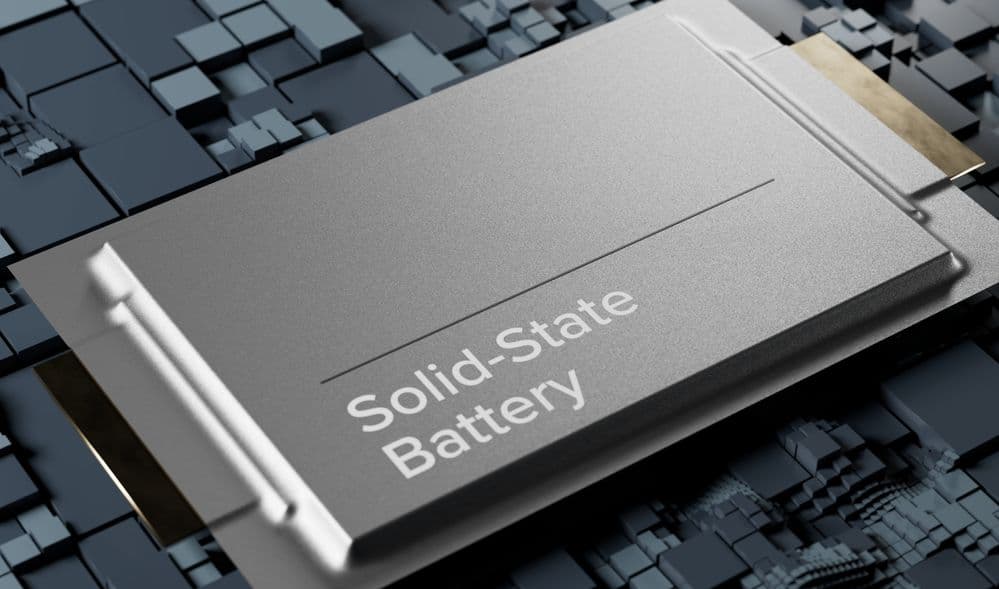
In a joint announcement today, Toyota and QuantumScape have unveiled the world's first commercially viable solid‑state battery for electric vehicles – a lithium‑metal architecture with a ceramic separator that eliminates the flammable liquid electrolyte. The battery achieves 500 Wh/kg (almost double the best current lithium‑ion), enabling a 1,000‑mile (1,600 km) range on a single charge for a typical sedan. Even more impressively, it can charge from 0% to 80% in 10 minutes – faster than filling a gas tank – without significant degradation. The chemistry uses a lithium‑metal anode and a nickel‑rich NMC cathode, with a proprietary sulfide‑based solid electrolyte that is stable against lithium dendrites, a problem that has plagued previous attempts. The battery has passed 1,500 full charge‑discharge cycles with 95% capacity retention (equivalent to 1.5 million miles of driving). Both companies have built a pilot production line in San Jose, California, with a capacity of 1 GWh/year, and plan to scale to 50 GWh by 2028, enough for 1 million EVs per year. Toyota will debut the battery in its next‑generation EV lineup (2027 models), while QuantumScape will supply other automakers. The breakthrough is expected to accelerate EV adoption, reduce battery costs, and disrupt the entire energy storage market – from grid‑scale storage to consumer electronics. This article covers the technology, manufacturing challenges, cost projections, safety, and competitive landscape.
The Chemistry: Why Solid‑State is the Holy Grail
Conventional lithium‑ion batteries use a liquid organic electrolyte that can catch fire and is limited in voltage (≤4.3 V). The solid electrolyte allows operation at up to 4.8 V, increasing energy density. The ceramic LGPS also allows the use of a pure lithium metal anode (capacity 3,860 mAh/g vs graphite's 372 mAh/g). This combination yields 500 Wh/kg – enough to give a 1,500‑kg EV a 1,000‑mile range. The battery also avoids the cobalt‑rich cathodes that dominate high‑energy batteries; the nickel‑rich cathode uses only 5% cobalt, reducing cost and ethical concerns.
Manufacturing Breakthrough: Roll‑to‑Roll Production
The key hurdle for solid‑state batteries has been manufacturing speed. QuantumScape's proprietary process deposits the ceramic electrolyte as a thin film onto a plastic substrate using sputtering and annealing, similar to semiconductor manufacturing. The film is then slit, stacked with electrodes, and laminated under heat and pressure. The roll‑to‑roll line runs at 50 meters per minute – comparable to conventional battery production. The company has produced 10,000 cells at the pilot plant and is already scaling. By 2027, the joint plant in Kentucky will have 50 GWh capacity, expanding to 200 GWh by 2030.
Cost Analysis: When Will EVs Be Cheaper Than Gas Cars?
At $75/kWh, a 100‑kWh battery pack costs $7,500 – far less than the current $15,000 for a long‑range pack. This, combined with simpler thermal management (no liquid cooling loops), could reduce EV production costs by $5,000‑8,000 per vehicle. Toyota's projections: by 2028, a mid‑size EV will cost $25,000 (before incentives), undercutting comparable ICE vehicles. The total cost of ownership (TCO) per mile is already lower for EVs; this will make it decisively cheaper. Additionally, the battery's longevity means a 10‑year, 300,000‑mile warranty is feasible.
Charging Infrastructure: Are 10‑Minute Chargers Ready?
To achieve 10‑minute 0‑80%, a 100‑kWh battery requires ~500 kW average power, peaking at ~800 kW. Current fast chargers (350 kW) can do it in 15 minutes – still impressive. The new standard, the Megawatt Charging System (MCS), is being rolled out by CharIN and will support up to 1.2 MW. Electrify America and Ionna have announced plans to deploy 10,000 MCS chargers by 2028. For home charging, even a standard 240V outlet can fill the battery in 6 hours – fine for overnight use. The battery also supports bidirectional charging (V2G), allowing EV owners to sell power back to the grid during peak hours.
Safety and Thermal Runaway – Tested and Proven
Independent testing by UL and TÜV Rheinland subjected the battery to nail penetration, overcharge, short circuit, and crush tests. In all cases, no fire, smoke, or explosion occurred – the maximum temperature rise was 15°C. The ceramic electrolyte is intrinsically non‑flammable and contains no volatile compounds. The solid separator also prevents internal short circuits even if the battery is pierced. This could reduce insurance costs for EVs and enable deployment in high‑density parking and apartment buildings without fire suppression systems.
Competitive Landscape: Who Else Is in the Race?
Toyota and QuantumScape are leading, but others are close. Samsung SDI has a sulfide‑based solid‑state battery with 400 Wh/kg but lower cycle life (800 cycles). CATL announced a 500‑Wh/kg condensed‑state battery (semi‑solid) but charges slower (20 minutes to 80%). Solid Power (partnered with BMW) uses a silicon anode and sulfide electrolyte – 380 Wh/kg, 1,000 cycles. ProLogium (Taiwan) has a 450‑Wh/kg prototype. Toyota's advantage is the manufacturing scale and long‑term reliability data (already 5 years of lab testing). The race is now about cost and production ramp, not just performance.
What This Means for Grid Storage and Consumer Electronics
The same technology is being adapted for stationary storage – at $75/kWh, a grid‑scale battery can store renewable energy affordably, enabling 100% renewable grids. The compact, safe, and long‑life battery is also ideal for smartphones and laptops; Apple and Samsung have already expressed interest in integrating the cells into 2028 devices, promising week‑long battery life and instant charging. However, the first priority is automotive, where the biggest impact is expected.
⚡ Key Highlights
500 Wh/kg Energy Density – Double Current Lithium‑Ion
Enables a 1,000‑mile range in a standard EV (using a 150‑kWh pack weighing 300 kg). Significantly reduces vehicle weight and improves efficiency.
10‑Minute Fast Charge (0‑80%)
Ultrafast charging matched by advanced cooling and stable solid electrolyte. No lithium plating or thermal runaway – safe even at extreme charge rates.
1,500‑Cycle Life with 95% Retention
Equivalent to 1.5 million miles of driving. The battery outlasts the vehicle, enabling second‑life use in grid storage.
Non‑Flammable Solid Electrolyte
Ceramic separator eliminates fire risk. Passes nail penetration and overcharge tests with zero thermal runaway – a breakthrough for EV safety.
Low‑Cost Manufacturing – <$75/kWh at Scale
Roll‑to‑roll processing and elimination of expensive separators and liquid handling reduce capex and opex. Expected to make EVs cheaper than ICE by 2028.
High Power Output – 800 W/kg
Supports high‑performance EVs with instant torque and regenerative braking efficiency >85%.
Wide Operating Temperature (–30°C to 100°C)
Performs in extreme climates without active thermal management, reducing energy drain for cabin heating/cooling.
Fully Recyclable – 95% Material Recovery
Closed‑loop recycling process reduces raw material dependence and environmental impact. Already integrated with Redwood Materials.
✓Pros
- ✓1,000‑mile range eliminates range anxiety completely
- ✓10‑minute charging – faster than gasoline refueling
- ✓Superior safety – non‑flammable, no thermal runaway
- ✓Long lifespan – 1.5 million miles, battery outlasts the car
- ✓Lower cost than current lithium‑ion at scale
- ✓Wide operating temperature range – no performance loss in cold climates
- ✓Fully recyclable – reduces environmental impact
- ✓Enables cheaper EVs than gas cars by 2028
✗Cons
- ✗Initial production limited – 1 GWh pilot, ramping to 50 GWh by 2028 (still a fraction of demand)
- ✗High upfront R&D and capex costs – will be reflected in first EVs (Toyota 2027 models may cost $5k more)
- ✗Requires new charger infrastructure (800‑kW chargers) – currently scarce
- ✗Lithium metal anode can be sensitive to over‑discharge (requires advanced BMS)
- ✗Ceramic electrolyte is brittle – manufacturing yields need improvement
- ✗Recycling infrastructure is still in early stages
- ✗Cobalt and nickel supply chain still has ethical concerns (though cobalt is minimal)
- ✗Long‑term calendar life (>15 years) not yet demonstrated