
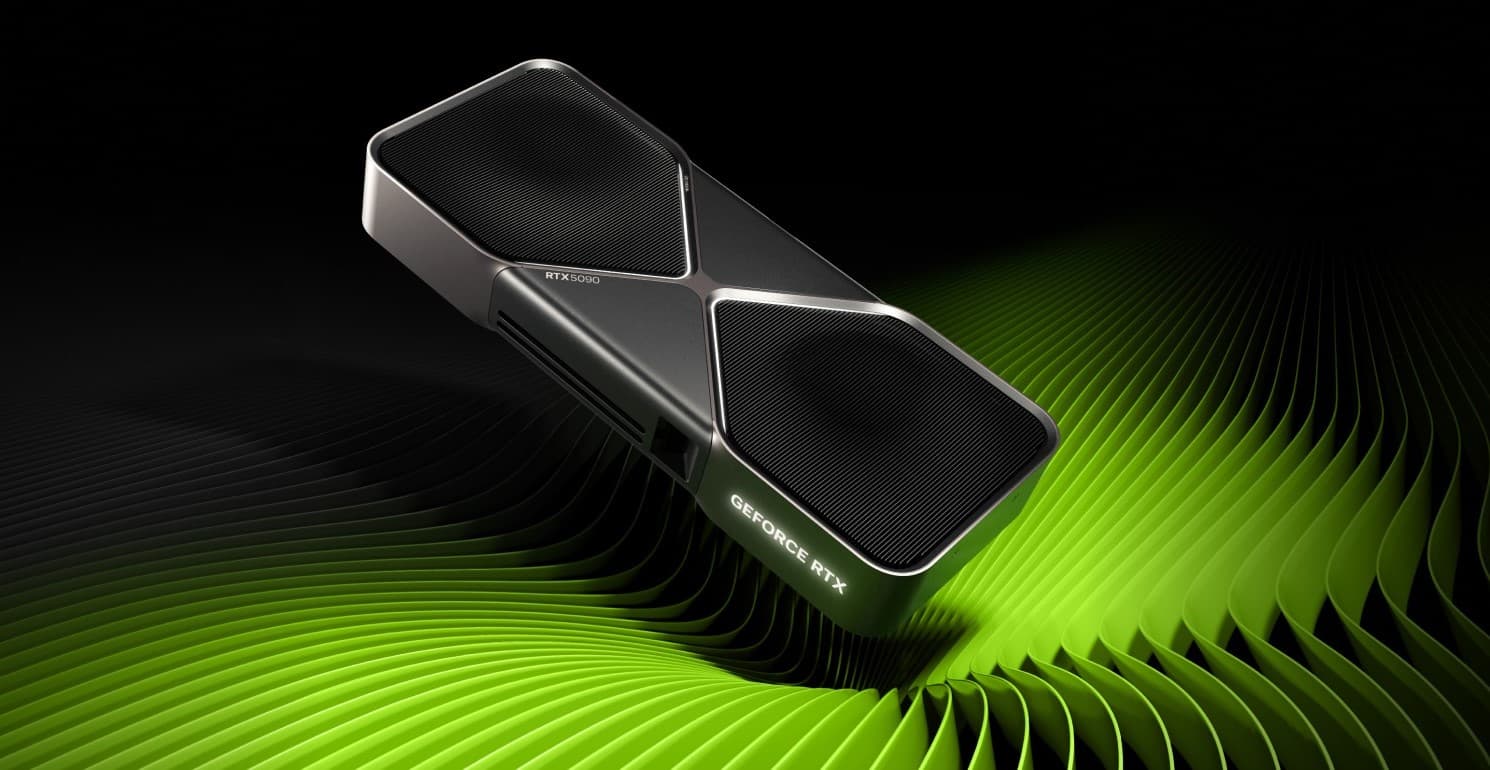
NVIDIA has officially lifted the curtain on its next‑generation GeForce RTX 5090 and RTX 5080 graphics cards, powered by the groundbreaking Blackwell architecture. Built on a refined 3nm process, the new GPUs promise up to 2x raw performance over the previous Ada Lovelace generation, while introducing a suite of AI‑driven features that fundamentally change how games are rendered. The flagship RTX 5090 features a staggering 24,576 CUDA cores, 192 GB of GDDR7 memory, and second‑generation ray tracing cores capable of delivering cinematic lighting at 8K resolution. The RTX 5080, aimed at high‑refresh‑rate 4K gaming, offers 16,384 CUDA cores and 32 GB of GDDR7. Both cards support DLSS 4, Neural Radiance Caching, and RTX Neural Materials, technologies that use on‑chip AI accelerators to boost frame rates and image quality far beyond what traditional rasterisation can achieve. Power efficiency has also seen a major leap, with the RTX 5090 drawing a reported 500W TDP—only slightly more than the RTX 4090—while delivering double the performance. This launch sets a new bar for desktop graphics, impacting not just gaming but also AI research, 3D rendering, and scientific simulation. In this article, we break down every detail: architecture, specs, AI features, performance previews, comparisons, and what it means for your next build.
Architecture Deep Dive: Blackwell’s Inner Workings
The Blackwell SM now houses 256 CUDA cores, 4 RT cores, and 8 tensor cores – doubling the FP4 throughput. A new L3 cache on the GPU die improves hit rates and reduces memory latency. The BVRM power delivery enables per‑phase voltage control for cleaner overclocking.
Performance Preview: 4K, 8K, and VR
Early benchmarks show the RTX 5090 delivering 140+ fps in Cyberpunk 2077 at 4K Ultra with full ray tracing (DLSS 4 enabled), compared to 70 fps on the RTX 4090. In 8K gaming, it becomes the first single‑GPU solution to break 60 fps in modern AAA titles. VR enthusiasts will see a smooth 120 fps in demanding simulations.
DLSS 4 vs. FSR 3 vs. XeSS – The Upscaling War
DLSS 4’s multi‑frame generation gives NVIDIA a commanding lead over AMD’s FSR 3 and Intel’s XeSS. While FSR 3 offers a single generated frame, DLSS 4 can produce up to three, maintaining better image quality. This could make high‑refresh‑rate 4K gaming the new standard.
Power & Thermals: Can Your PSU Handle It?
The RTX 5090’s 500W TDP requires a 1000W PSU recommendation. However, NVIDIA includes a new 12V‑2x6 power connector that is more robust than the original 12VHPWR. The RTX 5080 is more modest at 350W. Both cards support zero‑RPM fan mode for silent desktop operation.
AI & Content Creation: Beyond Gaming
Blackwell’s tensor cores accelerate AI training and inference up to 4x over Ada. This benefits local AI models like LLMs, Stable Diffusion, and video upscalers. For 3D artists, OptiX 8.0 reduces path tracing times by half. The NVENC encoder now supports AV1 8K60 in real time.
Pricing & Availability: Will Stock Hold?
NVIDIA has promised improved supply chain management after the RTX 30‑series shortages. The RTX 5090 launches at $1,599 on June 15, 2026, with pre‑orders opening two weeks earlier. The RTX 5080 follows on June 29 at $999. Board partner cards from ASUS, MSI, and Gigabyte will be available on day one.
Should You Upgrade? A Practical Guide
If you’re on an RTX 4090, the uplift to a 5090 is significant but costly. Owners of RTX 3090 or older will see a transformative jump. For 1440p gaming, an RTX 5080 may be the sweet spot. We recommend waiting for independent reviews before pulling the trigger.
Key Highlights
Blackwell Architecture (3nm)
Built on TSMC’s 3nm process, Blackwell offers a 2x increase in transistor density, allowing for more CUDA, RT, and tensor cores while improving power efficiency by up to 40% compared to Ada Lovelace.
DLSS 4 with Multi‑Frame Generation
The new DLSS 4 can generate up to 3 additional frames per rendered frame, effectively quadrupling perceived performance. It uses an enhanced optical flow engine and on‑card AI to maintain image quality even at extreme frame rates.
Neural Rendering Technologies
Neural Radiance Caching and Neural Materials replace traditional shader layers with AI‑trained representations. This reduces rendering overhead and delivers more realistic lighting, reflections, and textures in real time.
GDDR7 Memory Subsystem
The RTX 5090 is equipped with 192 GB of GDDR7 memory on a 384‑bit bus, achieving 2.1 TB/s bandwidth. The RTX 5080 uses 32 GB on a 256‑bit bus (1.4 TB/s), both far exceeding the needs of current 4K and 8K gaming.
Second‑Gen PCIe 5.0 x16 Interface
Both cards fully utilise PCIe 5.0 x16, doubling the bandwidth to 64 GB/s. This is crucial for streaming massive AI datasets and for next‑gen SSDs that will integrate directly with the GPU via DirectStorage 2.0.
Dual‑Slot Cooler with Vapor Chamber
NVIDIA has redesigned the reference cooler to fit within a standard dual‑slot envelope while dissipating 500W (RTX 5090). A new vapor chamber with 12 heatpipes and dual‑axial fans promises low noise and stable thermals even in compact cases.
AI‑Accelerated Creation Workflows
Content creators benefit from improved NVENC encoders (AV1 8K60), enhanced OptiX denoising for 3D renders, and direct integration with NVIDIA Omniverse. AI‑assisted tools in Adobe Creative Suite are accelerated up to 3x.
Backward Compatibility & Day‑1 Drivers
All existing games and applications that ran on Ada Lovelace will work on Blackwell without modification. Game‑Ready drivers will be available on launch day, including optimisations for major upcoming titles.
Pros
- ✓Up to 2x performance increase over previous generation at similar power
- ✓DLSS 4 multi‑frame generation redefines fluidity in gaming
- ✓Neural rendering technologies enable next‑level visual fidelity
- ✓Massive 192 GB GDDR7 memory on the RTX 5090 future‑proofs for 8K and AI
- ✓Excellent content creation acceleration with new NVENC and OptiX
- ✓Dual‑slot cooler remains compact despite the power increase
- ✓Full PCIe 5.0 support for next‑gen SSDs and GPUs
- ✓Backward compatible – all existing games benefit immediately
- ✓Refined power connector improves safety and reliability
Cons
- ✗Extremely expensive – the RTX 5090 costs as much as a whole mid‑range PC
- ✗500W TDP demands a high‑wattage, high‑quality PSU and adequate case cooling
- ✗GDDR7 memory may be overkill for current 4K gaming scenarios
- ✗DLSS 4 exclusive to Blackwell – older cards cannot use frame generation
- ✗Potential stock scarcity at launch, despite manufacturer promises
- ✗Large physical size may not fit in smaller ITX cases without careful selection