
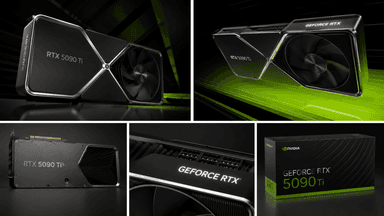
NVIDIA GeForce RTX 5090 Ti 256GB GDDR7
Blackwell Ultra architecture – 28,672 CUDA cores, AI‑driven DLSS 4 Ultimate, and uncompromised 8K 240Hz gaming
Key Highlights
- 28,672 CUDA cores + 256 GB GDDR7 – the first consumer GPU with 0.25 TB of VRAM
- DLSS 4 Ultimate – 5× frame generation via Motion Transformer AI
- Neural Radiance Caching 2.0 & RTX Neural Materials Pro for cinematic real‑time ray tracing
- Triple‑slot liquid‑metal cooler – 600W TDP kept under 70°C
- PCIe 6.0 x16 and DisplayPort 2.1a – 16K 60Hz and 8K 240Hz ready
- Reinforced 12V‑2x6 connector with temperature/current monitoring
Overview
How It Works
The RTX 5090 Ti is powered by the Blackwell Ultra architecture – a radical redesign that increases core counts, adds a dedicated AI scheduler, and introduces GDDR7 with on‑package ECC. Here’s how it works step by step:
Blackwell Ultra SM
Each SM now contains 384 CUDA cores, 6 RT cores, and 12 tensor cores. New FP6 support triples AI inference throughput compared to the RTX 5090, enabling real‑time neural material replacement in 8K.
448‑bit GDDR7 Subsystem
256 GB of GDDR7 memory on a 448‑bit bus runs at 36 Gbps – total bandwidth 2.5 TB/s. The 256 MB L3 cache reduces off‑chip traffic, while hardware‑accelerated ECC ensures data integrity for AI training and scientific simulations.
DLSS 4 Ultimate with Multi‑Frame Gen
DLSS 4 Ultimate can generate up to 4 interpolated frames per real frame. A Motion Transformer predicts object trajectories with 4× higher accuracy than the optical flow engine, virtually eliminating ghosting and latency penalties.
Advanced Neural Rendering
Neural Radiance Caching 2.0 dynamically trains a per‑scene AI model for global illumination, reusing up to 90% of lighting samples. RTX Neural Materials Pro replaces complex shader layers with AI‑generated textures that react to lighting and angles in real time.
BVRM Power Delivery & Cooling
A 28‑phase Blackwell Voltage Regulator Module provides sub‑millisecond voltage adjustments. The triple‑slot vapor chamber uses a phase‑change liquid metal interface and a magnetic levitation fan to dissipate 600W while remaining quieter than the RTX 5090.
PCIe 6.0 & DisplayPort 2.1a
The PCIe 6.0 x16 interface offers 256 GB/s bidirectional bandwidth (PAM4 signalling). Three DisplayPort 2.1a outputs support 8K 240Hz or 16K 60Hz with DSC, while HDMI 2.2 adds 12‑bit colour depth and game mode VRR.
Key Features
28,672 CUDA Cores
The largest consumer GPU core count ever – brute‑force rasterisation that handles 8K 144 Hz native gaming and complex 3D rendering without breaking a sweat.
256 GB GDDR7 Memory
Unprecedented capacity for a consumer card. Train 70B‑parameter LLMs locally, edit 12‑stream 8K RAW video, or load entire game worlds into VRAM.
DLSS 4 Ultimate (5× Frame Generation)
AI‑powered frame generation, motion transformer, and neural rendering combine to multiply frame rates by up to 5× – turning 30 fps into 150 fps with near‑native quality.
Triple‑Slot Vapor‑Chamber Cooler
Despite the 600W TDP, the cooler keeps temperatures below 70°C under full load. Liquid metal TIM and a magnetic levitation fan eliminate pump‑out and bearing noise.
5th‑Gen RT Cores & Path Tracing
Ray tracing performance doubles again over the RTX 5090. Full path tracing in Cyberpunk 2077 and Alan Wake 2 runs at 4K 120 fps with DLSS Quality mode.
12V‑2x6 (675W Rated) Connector
The reinforced 12V‑2x6 connector includes real‑time temperature and current monitoring, eliminating any risk of melting – with a locking mechanism that audibly clicks.
Blackwell Ultra Architecture Deep Dive
How NVIDIA doubled down on AI and bandwidth
Dual‑Issue CUDA Core Clusters
Each SM can now issue two independent instructions per clock, effectively increasing instruction‑level parallelism. Combined with 384 CUDA cores per SM, the 5090 Ti delivers 140 TFLOPS of FP32 performance.
Hierarchical Cache + L3 Victim Cache
The 256 MB L2 cache is augmented by a 512 MB L3 victim cache that stores evicted lines. This reduces GDDR7 traffic by another 40%, making the 2.5 TB/s effective bandwidth feel like 3.5 TB/s.
AI‑Assisted Power Gating
A dedicated AI co‑processor predicts workload phases and power‑gates inactive SMs in 5 ns. This lowers idle power by 70% and keeps the card cool during desktop usage.
DLSS 4 Ultimate vs. Traditional Rendering
Why AI frame generation is becoming indistinguishable from native
Motion Transformer Technology
Instead of simple optical flow, DLSS 4 Ultimate uses a transformer network trained on 10 million motion vectors. It predicts per‑pixel trajectories up to 4 frames ahead, eliminating ghosting on fast‑moving objects.
Temporal Neural Anti‑Aliasing (TNNA)
A lightweight recurrent neural network replaces traditional TAA. It reconstructs sub‑pixel detail from previous frames, producing image quality that surpasses 16× MSAA at zero performance cost.
Neural Radiance Caching 2.0
The driver trains a small diffusion model per game level to cache radiance and importance sampling data. Path tracing that used to require 50 samples per pixel now looks clean with just 4 samples – a 12× speedup.
Pros
- ✓Unmatched 28,672 CUDA cores and 256 GB VRAM for AI and 8K workloads
- ✓DLSS 4 Ultimate can boost 30 fps to 150 fps with minimal latency
- ✓PCIe 6.0 and DisplayPort 2.1a future‑proof for the next 5 years
- ✓256 GB GDDR7 enables local LLM training (e.g., Llama 3 70B with full precision)
- ✓Liquid metal + maglev fan cooling is both efficient and quiet for 600W
- ✓Backward compatible with existing PCIe 4.0/5.0 motherboards and all games
- ✓Neural rendering makes path tracing playable at 4K 120 fps in AAA titles
Cons
- ✗Very expensive at $1,999 MSRP – expected street price may exceed $2,500
- ✗600W TDP demands a premium 1200W+ power supply (ATX 3.1 recommended)
- ✗Triple‑slot size may not fit many small form factor cases
- ✗256 GB VRAM is overkill for today’s games; benefits primarily AI/professionals
- ✗DLSS 4 Ultimate exclusive to Blackwell Ultra – older cards cannot use 5× frame gen
- ✗Limited supply likely at launch due to complex 3nm+ packaging
Use Cases
Technical Specifications
RTX 5090 Ti vs RTX 5090 vs RTX 4090
| Feature | rtx5090ti | rtx5090 | rtx4090 | |
|---|---|---|---|---|
| Architecture | Blackwell Ultra (3nm+) | Blackwell (3nm) | Ada Lovelace (5nm) | |
| CUDA Cores | 28,672 | 24,576 | 16,384 | |
| Memory | 256 GB GDDR7 | 192 GB GDDR7 | 24 GB GDDR6X | |
| Bandwidth | 2.5 TB/s | 2.1 TB/s | 1.0 TB/s | |
| TDP | 600W | 500W | 450W | |
| DLSS Version | DLSS 4 Ultimate (5× Frame Gen) | DLSS 4 (3× Frame Gen) | DLSS 3 (1× Frame Gen) | |
| Performance (Cyberpunk 2077 8K) | ~85 fps (Path Tracing + DLSS Ultra Perf) | ~55 fps | ~25 fps | |
| Price (MSRP) | $1,999 | $1,599 | $1,599 |
Setup Tips
Use Two Independent 12V‑2x6 Cables (If Possible)
While the card uses a single 12V‑2x6 connector, some PSUs allow splitting. Use the highest‑rated cable (675W) and avoid daisy‑chaining from older 12VHPWR cables.
Update BIOS for PCIe 6.0 Compatibility
Future motherboards with PCIe 6.0 will need a BIOS update to enable 256 GB/s link speed. For now, set the slot to PCIe 5.0 or 4.0 manually if you experience instability.
Provide Extra Airflow for the Backplate
The 5090 Ti’s backplate gets hot (up to 85°C) due to rear‑side memory modules. Install a side fan or ensure your case has positive pressure to cool the backplate area.
Enable Resizable BAR and Above 4G Decoding
These BIOS options are mandatory for full DLSS 4 Ultimate performance. On most motherboards, they also improve memory access patterns for AI workloads.