

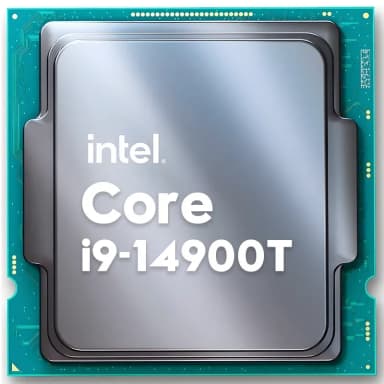
Intel Core i9-14901TE 8‑Core LGA1700 Embedded Processor (Power‑Optimized)
Embedded flagship with 8 high‑performance cores, 5.5 GHz boost, and 45W TDP – designed for fan‑less industrial systems, edge computing, and thermally constrained environments.
Key Highlights
- 8 high‑performance P‑cores / 16 threads – no E‑cores, deterministic performance
- 5.5 GHz max turbo – excellent single‑thread burst performance
- 45W base power (configurable to 35W) – ideal for fan‑less and silent embedded systems
- Supports ECC DDR5/DDR4 – critical for industrial reliability
- Full Intel vPro Enterprise with AMT – remote management for distributed fleets
- PCIe 5.0 (16 lanes) + PCIe 4.0 (4 lanes) – high‑speed I/O in low‑power envelope
- Long embedded lifecycle – 7+ years of availability for OEMs
Overview
How It Works
The i9-14901TE brings flagship embedded performance to a 45W power envelope. Here’s how it achieves that balance:
Pure P‑Core Architecture
Eight Raptor Cove P‑cores (no E‑cores) provide deterministic, low‑latency performance for real‑time industrial control and edge computing. All cores are identical, simplifying scheduling.
Intelligent Power Scaling
The processor defaults to a 45W PL1 (long‑term power) but can burst up to 140W (PL2) for short periods. This allows high turbo clocks (5.5 GHz) while maintaining low average power and heat.
Thermal Velocity Boost (TVB)
When the chip runs below 70°C and has power budget, TVB adds +100–200 MHz to the max turbo, pushing a single core to 5.5 GHz for bursty, latency‑sensitive tasks.
ECC Memory & Enterprise Reliability
Supports ECC DDR5/DDR4 to detect and correct single‑bit memory errors – critical for medical, industrial, and networking gear that cannot tolerate data corruption.
Intel vPro & Remote Management
Integrated Intel Active Management Technology (AMT) allows remote power cycling, BIOS updates, and OS recovery even when the system is unresponsive – essential for distributed embedded fleets.
Key Features
8 Performance Cores (No E‑Cores)
Eight high‑performance Raptor Cove cores deliver 16 threads, with no hybrid complexity – deterministic, consistent performance for real‑time embedded applications.
5.5 GHz Max Turbo
Intel Thermal Velocity Boost pushes a single core to 5.5 GHz, offering industry‑leading single‑thread performance for a sub‑45W embedded processor.
45W Base Power (Configurable)
Processor Base Power of 45W (PL1), configurable down to 35W for extreme thermal constraints. Maximum Turbo Power (PL2) is 140W for short bursts.
36 MB L3 + 16 MB L2 Cache
Large 36 MB shared L3 cache reduces memory latency. 2 MB L2 per core (16 MB total) provides ultra‑fast cache for deterministic real‑time workloads.
DDR5/DDR4 with ECC Support
Supports both DDR5-5600 and DDR4-3200 memory with full ECC error correction – essential for industrial, medical, and networking environments.
PCIe 5.0 & 4.0 (20 Lanes)
16 lanes of PCIe 5.0 and 4 lanes of PCIe 4.0 enable high‑speed GPUs, NVMe storage, or AI accelerators, all within a low‑power embedded footprint.
Intel vPro® Enterprise
Full vPro suite including Intel AMT for remote KVM, power management, and hardware‑level security – ideal for managing large fleets of embedded devices.
Integrated UHD Graphics 770
32 execution units with Intel Quick Sync for hardware‑accelerated video encoding/decoding – perfect for digital signage, video surveillance, and edge AI.
Balancing Power and Performance: The 14901TE in Fan‑Less Systems
How a 45W TDP delivers 5.5 GHz burst performance
PL1 / PL2 Configuration
The 14901TE is designed with a 45W long‑term power limit (PL1) and a 140W short‑term boost (PL2). In a fan‑less chassis with a large heatsink, the CPU can sustain 45W indefinitely, but can boost to 5.5 GHz for up to 28 seconds (or until thermal limits are hit). This matches bursty industrial workloads well – e.g., processing a sensor data spike or rendering a UI update.
Thermal Solutions
Passive cooling solutions (extruded aluminum heatsinks with heat pipes) can handle 45W in well‑ventilated enclosures. For truly sealed, fan‑less systems, designers often set PL1 to 35W and reduce boost duration. The chip remains fully functional with only a modest drop in sustained performance.
Real‑Time Determinism
Because there are no E‑cores, all eight cores have identical instruction latencies and cache hierarchies. This avoids the ‘Thread Director’ scheduling overhead, making the 14901TE ideal for real‑time operating systems (RTOS) like VxWorks, QNX, or Linux with PREEMPT_RT.
Comparison to 14901E
The standard 14901E has a 65W PL1 and 219W PL2, with a 5.6 GHz turbo. The TE version cuts base power by 30%, reduces turbo power by 36%, and lowers max boost by only 100 MHz (5.5 vs 5.6 GHz). This makes the TE dramatically more thermally efficient for a minor clock trade‑off.
✓ Pros
- ✓Exceptional single‑thread performance for a 45W chip – 5.5 GHz boost
- ✓Pure P‑core design – deterministic, low‑latency, no hybrid scheduling complexity
- ✓Very low 45W base power – enables fan‑less industrial enclosures
- ✓Supports ECC memory – critical for error‑sensitive applications
- ✓Full Intel vPro with AMT – remote management for embedded fleets
- ✓Integrated UHD Graphics 770 with Quick Sync – hardware video encode/decode
- ✓PCIe 5.0 support – high‑speed I/O even in low‑power designs
- ✓Long embedded lifecycle – extended availability for OEMs (typically 7+ years)
✗ Cons
- ✗Only 8 cores / 16 threads – much lower multi‑core throughput than consumer 14900K
- ✗Not available in retail – only sold to OEMs and system integrators
- ✗Lower boost clock than 14901E (5.5 vs 5.6 GHz) and much lower PL2 (140W vs 219W)
- ✗Locked multiplier – no overclocking
- ✗Requires specialized embedded motherboards (Q670E, H610E, W680) – not compatible with most consumer boards
- ✗Higher cost per core than standard desktop CPUs
- ✗Maximum turbo power of 140W still requires a decent heatsink – not completely passive in all cases
- ✗No E‑cores for background task offloading – multitasking may impact foreground performance
Use Cases
Technical Specifications
Core i9-14901TE vs i9-14901E vs i9-13900TE vs Ryzen Embedded V3C48
| Feature | i9‑14901TE | i9‑14901E | i9‑13900TE | V3C48 | |
|---|---|---|---|---|---|
| Cores / Threads | 8 / 16 | 8 / 16 | 24 / 32 | 8 / 16 | |
| Max Boost | 5.5 GHz | 5.6 GHz | 5.0 GHz | 3.8 GHz | |
| Base Power (PL1/TDP) | 45W | 65W | 35W | 45W | |
| Turbo Power (PL2) | 140W | 219W | 106W | N/A | |
| E‑cores | None | None | 16 | N/A | |
| ECC Memory | Yes | Yes | Yes | Yes | |
| Integrated GPU | UHD 770 | UHD 770 | UHD 770 | None | |
| vPro Support | Yes | Yes | Yes | No |
Setup Tips
Choose the Right Heatsink for Your Power Target
If you plan to run the chip at its full 45W PL1, use a passive heatsink rated for at least 60W (e.g., a large finned aluminum block with heat pipes). For fan‑less operation, a chassis that acts as a heatsink (conduction‑cooled) is ideal. If you can tolerate a small fan, a 40mm or 60mm low‑noise fan on a compact heatsink will easily handle 45W.
Configure Power Limits in BIOS
Enter the BIOS and set PL1 (long‑term) to your target (e.g., 45W for standard, 35W for extreme low power). Set PL2 (turbo) to a maximum that your cooling can handle (default 140W, but can be lowered to 90W for fan‑less systems). Adjust the tau (time window) to match your workload – shorter tau reduces heat build‑up.
Enable ECC Memory Support
If using ECC RAM, ensure the BIOS has ECC enabled (often under ‘Memory Configuration’). Check that the OS reports ECC correction statistics (e.g., ‘edac‑util’ on Linux). This is vital for applications that cannot risk data corruption.
Deploy Intel vPro AMT
For remote management, set up Intel AMT during initial provisioning. Configure the Management Engine (ME) with a secure password, network settings, and enable KVM redirection. This allows you to manage the system from anywhere, even if the OS crashes.
Optimize for Real‑Time
If running an RTOS or real‑time Linux, disable Intel SpeedStep and C‑states in the BIOS to reduce latency. Use the `intel_pstate=passive` kernel parameter and isolate cores for time‑critical tasks. The pure P‑core design simplifies this significantly compared to hybrid chips.