
Anthropic has announced that Claude Code will shift to 'auto mode' as the default for paid users, while also updating its voice mode to support advanced models and additional languages.
Transition to Autonomous Coding
Starting August 14, Anthropic is setting 'auto mode' as the standard configuration for its Claude Code tool across Pro, Max, and Team accounts. Initially introduced in March as a test feature, auto mode changes the user interaction model significantly. Instead of requiring manual authorization for every individual step in a coding task, the AI will now execute actions autonomously. The system is designed to pause for human intervention only when an operation is identified as potentially destructive, irreversible, or if it involves actions outside the user's defined local environment. The company frames this as a necessary shift to improve efficiency, noting that human reviewers often fall into a state of habitual approval, accepting approximately 97% of permission prompts without thorough scrutiny.
Safety and Performance Data
Anthropic contends that the move to autonomous operation actually enhances security protocols. Data gathered from 1,053 paid participants revealed that auto mode was substantially more effective at identifying and blocking harmful actions than human users were during manual review sessions. Specifically, the system caught 89% of potential threats compared to the 13.6% detection rate observed with human oversight. To mitigate risks in this new autonomous workflow, Anthropic has integrated additional safeguards, including prompt injection screening and customizable hard-deny rules. These features are intended to prevent unauthorized data exfiltration, allowing users to define strict boundaries for what the AI is permitted to access while operating in its more autonomous state.
Advancements in Voice Interaction
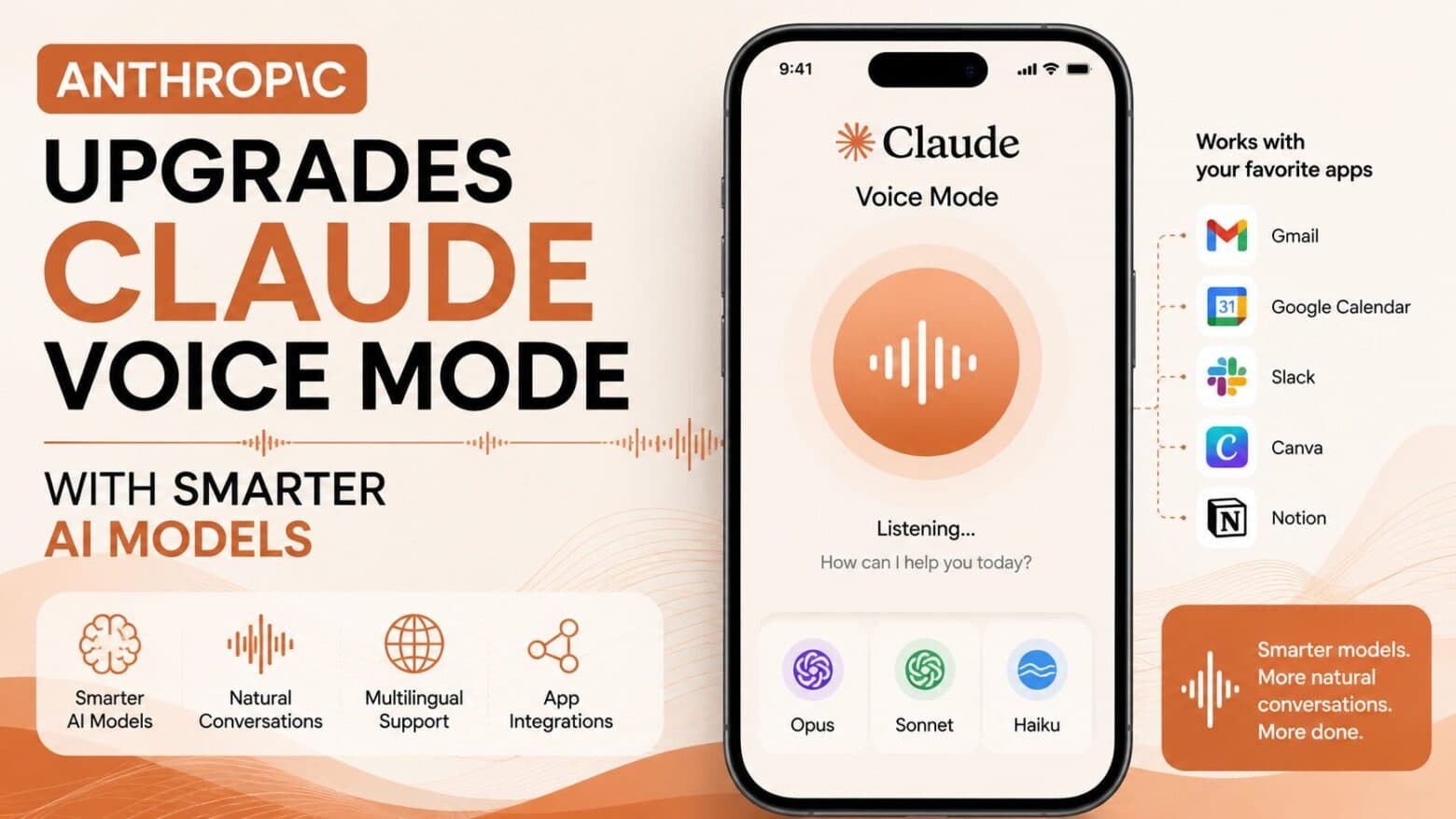
Beyond developer tools, Anthropic has significantly upgraded its voice mode, which has been evolving since its inception in 2025. A notable enhancement is the integration of more powerful models, including Sonnet and Opus, which are no longer restricted to the entry-level Haiku model. This shift allows the voice interface to tap into complex reasoning capabilities and pull relevant context from connected services like Gmail, Slack, and Google Calendar. The system now supports 14 languages, with several offering regional dialects. Users can further personalize their experience by selecting from five English-language voice tones—Buttery, Airy, Mellow, Glassy, and Rounded—and adjusting the cadence speed of the AI’s responses.
Operational Mechanics and Limitations
Claude's current voice mode relies on a 'turn-based' architecture, which differs from the 'duplex' systems found in competitors like OpenAI’s ChatGPT. In this structure, the model must fully listen to and process a user's input before it begins generating a response. This mechanical constraint means the system can occasionally misinterpret short pauses as the conclusion of a sentence or command. Consequently, Anthropic advises users to present multi-part questions sequentially rather than in a single block to ensure accuracy. Furthermore, the system cannot currently detect language switching mid-sentence; users must either declare their intent to switch languages vocally or manually adjust the language settings within the app menu.
⚖ The Balanced View
Supporting view
Proponents like Claude Code Head Boris Cherny argue that auto mode is a productivity breakthrough, stating that the internal team uses the feature exclusively and finds traditional permission prompts unnecessary.
Concerns & criticism
The system utilizes a turn-based architecture that can lead to misinterpretation of speech during natural pauses, and human reliance on manual confirmation remains a concern due to the risk of users habituating to approval prompts.
→What's next
Users should look for the shift to auto mode default on August 14. Additionally, as Anthropic continues to refine voice interaction, developers and casual users alike should monitor for potential updates that might move the architecture closer to duplex-style processing.