
Humanoid robots have officially surpassed Usain Bolt’s legendary 100-meter dash record during the second annual World Humanoid Robot Games in Beijing. While these machines have achieved unprecedented speed, their inability to stop safely highlights the current technical limitations in their movement and braking systems.
Record-Breaking Athleticism
The second annual World Humanoid Robot Games has served as the stage for a significant milestone in bipedal robotics. During a preliminary heat in Beijing, the Tiangong Ultra, a machine engineered by the Beijing Humanoid Robot Innovation Center, completed the 100-meter dash in an impressive 9.39 seconds. This performance eclipsed the long-standing human world record of 9.58 seconds established by Usain Bolt in 2009. The competition was fierce, with Honor’s Lightning robot also delivering a sub-record performance by crossing the line in 9.47 seconds. The progress demonstrated at this year’s games is substantial; last year, the Tiangong Ultra required 21.5 seconds to complete the same distance, indicating that hardware and software efficiency in these platforms has improved drastically within a single calendar year.
Technical Realities and Braking Failures
While the speed metrics are undeniably impressive, the physical reality of these robots in motion reveals significant technical gaps. Unlike human athletes who possess intuitive control over their momentum, these machines face severe challenges when attempting to decelerate after a sprint. Observers at the event noted that the robots do not come to a controlled halt; instead, they collide directly into heavy-duty crash pads at high velocities. In many instances, the physical trauma of the impact is so severe that the units require manual intervention and must be transported away from the track on stretchers. This lack of braking capability underscores that while these robots can replicate the explosive acceleration of an elite athlete, they currently lack the complex motor coordination required to manage deceleration safely or navigate a finish line effectively.
Event Scope and Broader Competition
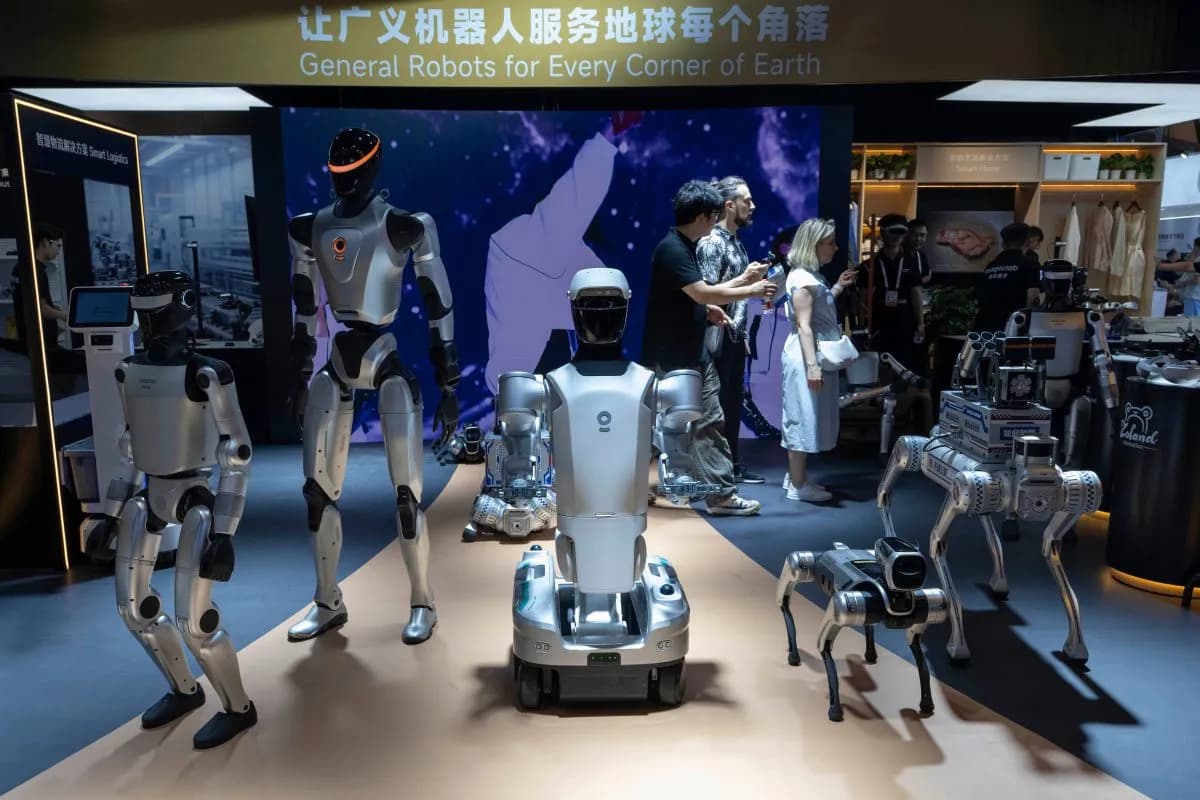
The World Humanoid Robot Games has expanded considerably since its inception in 2025. This year, the event features over 2,000 robots representing 16 different countries, participating in a diverse range of athletic endeavors including football, table tennis, jumping, and boxing. Beyond the main stadium events, local companies have used the Beijing games as a platform to exhibit the endurance and versatility of their inventions. For instance, a separate half-marathon event allowed robots to demonstrate sustained movement, with the Honor Lightning model securing a victory with a time of 50 minutes and 26 seconds. The event, which began on August 22 and runs through August 26, is effectively functioning as an annual robot olympics, providing a rigorous testing ground for the current state of bipedal mobility.
Industry Implications
The transition from last year’s relatively slow performance to today’s record-shattering speeds highlights the rapid pace of development in the Chinese robotics sector. However, the contrast between these high-speed feats and the need for medical-style recovery teams for the robots suggests that commercial viability remains a distant goal. These machines are not currently engineered for consumer-facing environments where precision, safety, and controlled movement are mandatory. Instead, the games serve as a highly visible research and development showcase. The spectacle of machines moving in arguably unnatural, unsettling ways while smashing human athletic records has captured global attention, prompting observers to consider how much faster these systems might evolve as control algorithms and power-to-weight ratios continue to be optimized by the participating innovation centers.
⚖ The Balanced View
Supporting view
Supporters view these games as a vital proof-of-concept for rapid improvements in bipedal locomotion, evidenced by the dramatic time reduction from last year's event.
Concerns & criticism
Critics point to the chaotic braking failures and the necessity for human-assisted removal of the robots as evidence that the technology is far from being commercially ready or safe for non-controlled environments.
→What's next
The World Humanoid Robot Games are scheduled to continue through August 26, with ongoing competitions in various sports. Industry watchers will likely monitor these events to see if developers can address the current stability and braking issues that plagued the sprinters during the opening heats.