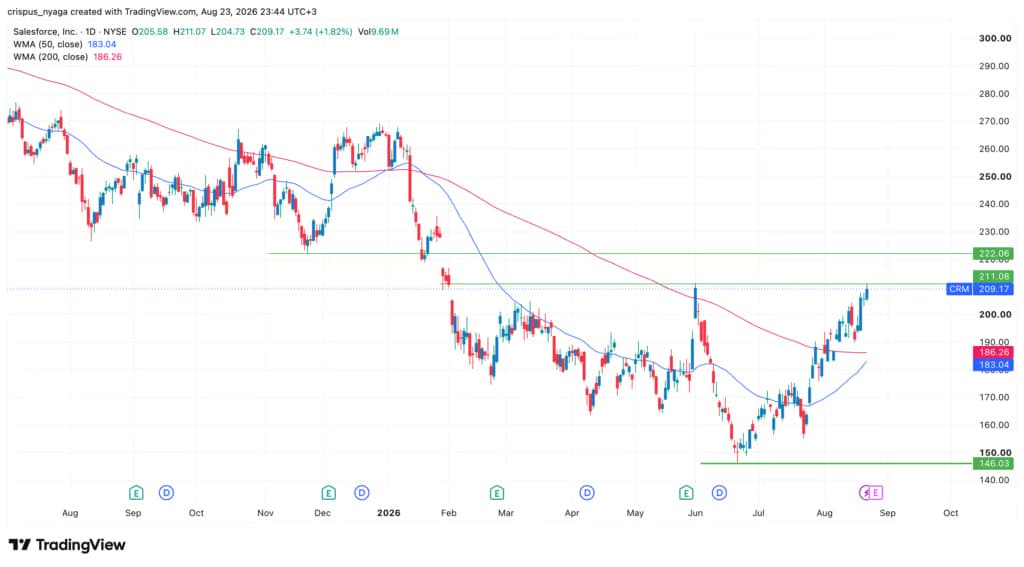

Salesforce stock surged following a positive second-quarter earnings report that exceeded analyst expectations and included an expanded partnership with AI firm Anthropic. CEO Marc Benioff dismissed industry concerns regarding the potential obsolescence of SaaS business models in the age of artificial intelligence.
Market Performance and Financial Results
Salesforce shares experienced a significant boost, climbing 22% on Thursday following the release of its fiscal second-quarter financial results. This surge represents the company’s second-best single-day stock performance in its history, trailing only a 26% increase recorded in August 2020. The company comfortably surpassed analyst expectations, reporting adjusted earnings of $5.90 per share against a consensus forecast of $3.27. Revenue also saw a positive trend, reaching $11.35 billion, an 11% increase compared to the same period in the previous year. This financial success helped alleviate concerns that had previously pressured the stock, which had faced a 22% decline year-to-date prior to these announcements. The positive momentum extended to other software companies, including Adobe, Palantir, and ServiceNow, as investors reacted to the overall strength shown by the enterprise software sector.
Debunking the 'SaaSpocalypse'
CEO Marc Benioff took the opportunity to address growing market anxieties regarding the long-term viability of the software-as-a-service (SaaS) business model in the face of generative AI advancements. Dismissing the 'SaaSpocalypse' narrative as nonsense, Benioff argued that instead of replacing traditional CRM platforms, frontier AI models are becoming increasingly dependent on the specific data and workflows that Salesforce maintains. According to the CEO, nine of the top ten leading AI companies are currently utilizing Salesforce and Slack products, with spending from these firms rising 435% year-over-year. Benioff emphasized that Salesforce operates primarily as a data business, providing the necessary security, controls, and context required for AI agents to function effectively. By positioning his platform as an essential foundation for artificial intelligence rather than a competitor, he sought to reassure investors that the company's core value proposition remains intact.
Strategic Expansion into Artificial Intelligence
The central feature of the company's AI strategy is the newly unveiled 'Claudeforce' initiative, a collaborative project with the AI startup Anthropic. This plugin allows sales professionals to interface directly with Anthropic’s Claude chatbot to access customer data stored within Salesforce’s environment. The tool is designed to assist with practical tasks such as updating records and generating emails. This partnership has proven financially lucrative beyond operational benefits, with Salesforce reporting a $2.6 billion gain on its strategic stake in Anthropic. Furthermore, Salesforce reported that annualized revenue from its own Agentforce AI products has climbed to $1.5 billion, marking a 240% increase compared to the previous year. These investments and product integrations serve as the company's primary evidence that AI is acting as a catalyst for growth rather than a disruptive force that threatens to cannibalize their existing customer base.
Broader Industry and Operational Context
While the overall outlook remains optimistic, the company noted mixed performance across different segments of its business. Management highlighted that while AI-driven products are seeing rapid adoption, there have been some headwinds and volatility regarding sales of integration and analytics software licenses. Operationally, the company is continuing to expand through both internal development and strategic acquisitions, such as the plan to purchase customer service startup Fin for $3.6 billion, a deal expected to finalize in the third quarter. Additionally, the company secured a significant $1.6 billion contract with the U.S. Department of Veterans Affairs. As of the end of the second quarter on July 31, Salesforce reported current remaining performance obligations of $33.5 billion, signaling stable revenue visibility for the upcoming year as they continue to refine their long-term guidance and financial forecasts in a shifting technological landscape.
⚖ The Balanced View
Supporting view
Salesforce management argues that its massive repository of customer data and security controls makes it an essential partner for AI developers rather than a victim of model-driven disruption.
Concerns & criticism
Prior to the earnings report, investors expressed fears that powerful generative AI models could allow businesses to bypass traditional subscription software or create their own tools, potentially undermining the SaaS pricing model.
→What's next
Salesforce projects fiscal third-quarter revenue to fall between $11.42 billion and $11.50 billion. The company maintains an optimistic full-year revenue outlook of $46.1 billion to $46.4 billion.