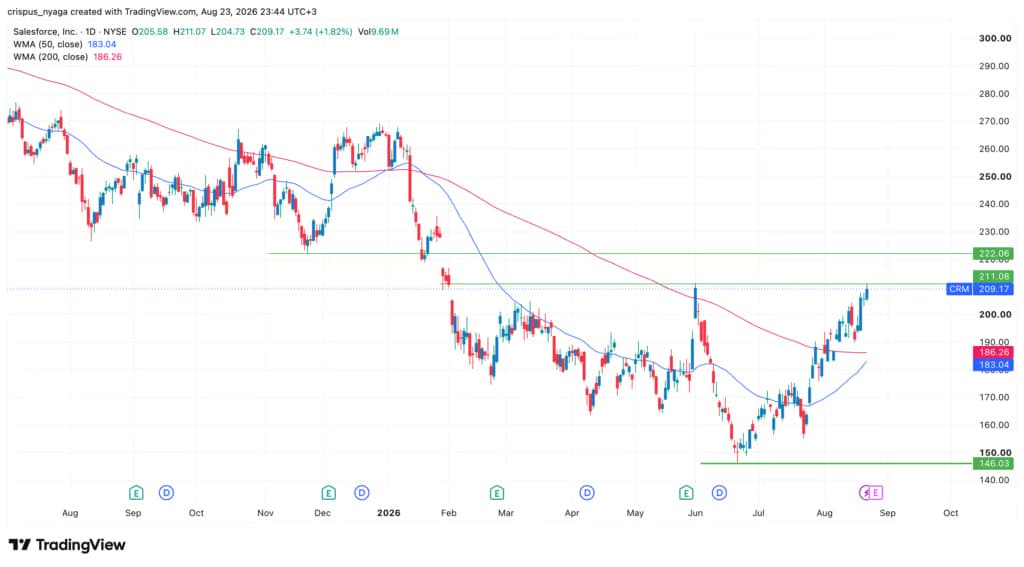

Salesforce reported strong quarterly earnings that defy the 'SaaSpocalypse' theory, demonstrating that enterprise software companies with deep data moats remain essential in the AI era. Instead of replacing legacy tools, AI agents are increasingly reliant on the trusted, proprietary information managed by platforms like Salesforce.
Challenging the 'SaaSpocalypse' Narrative
For over a year, financial markets have struggled with the 'SaaSpocalypse' theory, a pervasive narrative suggesting that artificial intelligence agents would inevitably render traditional software companies obsolete. Investors feared that large language models would commoditize existing enterprise tools by automating away the tasks those programs were originally designed to perform. However, recent earnings performance from Salesforce has fundamentally challenged this view. Instead of seeing a decline in usage, the company reported significant growth across its core service, sales, and Slack offerings. Rather than witnessing a contraction in seat counts or customer abandonment, Salesforce saw its highest net new average order value growth in four years. This evidence suggests that the market's initial, pessimistic assessment of software viability in an agent-driven world was incorrect, as customers continue to find value in the stability and specific functionality provided by established platforms.
The Strategic Importance of Data Moats
The central argument in the current debate over AI-era software value is the distinction between raw intelligence and actionable, trusted data. While frontier AI models are improving rapidly and becoming increasingly interchangeable—a process that effectively commoditizes intelligence—the value has begun to shift toward the scarce assets those models need to operate. Enterprises possess massive amounts of proprietary information that AI agents require to be truly useful. Salesforce, which handles vast repositories of customer records, has positioned itself as the underlying architecture for these AI agents. This past quarter, the company's 'Data 360' system ingested 104 trillion customer records, representing a 355% increase year over year. As artificial intelligence continues to expand, it generates even more data that requires a secure, organized environment, creating a powerful 'flywheel' effect where the platform becomes increasingly indispensable as it scales.
AI Companies as Customers, Not Competitors
A defining moment for the industry is the realization that the primary developers of frontier AI models are becoming the largest customers of established enterprise software providers. Rather than attempting to disintermediate platforms like Salesforce, industry leaders are actively integrating with them. Data indicates that nine of the top ten AI companies currently utilize Salesforce and Slack infrastructure, with their collective spending rising 435% compared to the previous year. This relationship was highlighted by the partnership between Anthropic and Salesforce to develop 'Claudeforce.' By acknowledging that their advanced models require a reliable CRM to function effectively, these AI labs are validating the necessity of traditional software. This collaboration underscores that the future of enterprise tech is likely a symbiotic one, where AI models rely on established data platforms to deliver results rather than attempting to operate in a vacuum.
Financial Performance and Future Outlook
Salesforce's financial results have outperformed consensus projections, providing tangible data to support the theory that software companies can thrive during the AI transition. The firm reported revenue growth of 11% to $11.35 billion, with adjusted earnings hitting $5.90 per share—a figure that significantly exceeded the $3.27 expectation set by analysts. Furthermore, the company reported a non-GAAP operating margin of 34.1% and increased its full-year guidance to as much as $46.4 billion. In response to this momentum, Salesforce announced a $25 billion buyback, marking the largest such effort in the company's history. This financial strength provides the company with the flexibility needed to reinvest in its AI capabilities, a luxury not shared by heavily indebted firms. As the industry evolves, companies with strong free cash flow and significant data moats are likely to emerge as the long-term structural winners of the artificial intelligence economy.
⚖ The Balanced View
Supporting view
Salesforce's performance data, including strong ARR growth for Agentforce and massive increases in customer record processing, suggests that enterprise software remains a critical, growing layer of the tech stack.
Concerns & criticism
While Salesforce is thriving, analysts suggest that firms lacking deep, proprietary data or those with high levels of debt and limited free cash flow may struggle to compete or invest appropriately in the AI transition.
→What's next
Industry observers will likely shift their focus toward identifying which other legacy software firms possess similarly deep, proprietary datasets that AI agents cannot function without. The ongoing financial performance of these companies will serve as a bellwether for whether the 'SaaSpocalypse' narrative is truly dead or if it simply requires a more nuanced understanding of company-specific moats.